There's a moment — often invisible to the untrained eye — when a building becomes a fire waiting to happen. A sprinkler system goes offline for scheduled maintenance. A construction crew wraps up for the night, leaving behind live wiring and combustible debris. A power outage knocks out half the safety infrastructure in a high-rise. In these windows of vulnerability, Fire Watch Guards become the last line of defense between a minor incident and a catastrophic, multi-million-dollar loss.
This isn't a niche concern. It's a nationwide operational reality that property managers, construction firms, hospitality groups, and industrial operators face constantly — often without fully understanding the financial and legal exposure they carry every hour their fire protection systems sit compromised.
The Hidden Cost of an Unguarded Building
Numbers tell the story quickly. The National Fire Protection Association has long documented that fires in commercial and industrial properties result in billions of dollars in direct losses annually — and those figures don't capture the downstream costs: litigation, insurance premium spikes, business interruption, regulatory penalties, and reputational damage that can linger for years.
What's less talked about is how many of these losses occur not because buildings lack fire suppression systems, but because those systems were temporarily offline and nobody was watching. A faulty alarm panel, a suppression system drained for maintenance, or a fire pumps taken out of service for repairs — each of these scenarios creates a window of exposure that, without professional oversight, goes completely unmonitored.
The business calculus here is stark. A single overnight fire watch service costs a fraction of what a commercial property owner would pay in deductibles alone after a preventable fire. Yet countless operators still treat fire watch as an optional line item rather than the critical risk management tool it actually is.
What Fire Watch Guards Actually Do
Most people imagine fire watch personnel as someone walking the perimeter with a flashlight. The reality is considerably more disciplined — and more valuable.
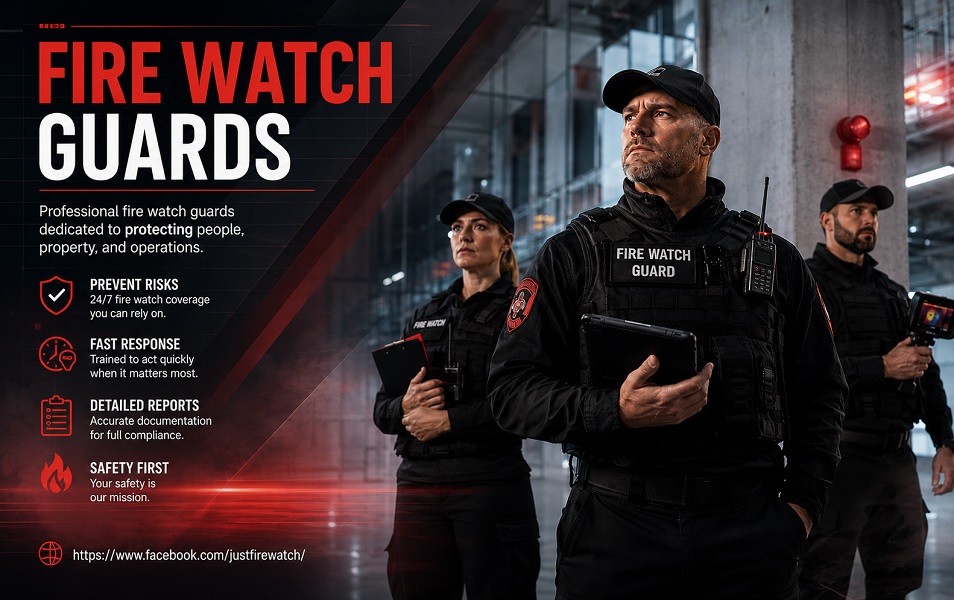
Trained fire watch professionals conduct systematic, documented patrols through a building or construction site at regular intervals. They're scanning for the early indicators that automated systems would normally catch: smoke accumulation, unusual heat sources, smoldering materials, electrical anomalies, or unauthorized activity near combustible areas. Every patrol round is logged, creating a paper trail that can prove critical during insurance claims or regulatory inspections.
They also serve as the operational bridge between a compromised fire system and emergency responders. When something looks wrong, they don't guess — they act. A properly trained guard knows exactly when to call 911, how to initiate evacuation protocols, and how to communicate building layout details to arriving firefighters. That knowledge, in a genuine emergency, is worth more than any suppression system that isn't running.
Beyond the tactical role, their presence functions as a deterrent. Properties with active fire watch protocols experience significantly fewer incidents involving negligent behavior around fire hazards — whether from construction crews, maintenance workers, or even building occupants.
Why Construction Sites Are Ground Zero for Fire Risk
The construction industry operates in a permanent state of controlled chaos. At any given moment, a mid-rise project might have hot work permits active across three floors, temporary electrical feeds running through areas with exposed insulation, propane-powered equipment staged near wooden framing, and fire suppression systems that haven't yet been installed or commissioned.
Every one of those conditions represents a fire risk that conventional building safety systems can't address — because those systems don't exist yet, or aren't operational. This is precisely why local fire codes and OSHA guidelines mandate fire watch coverage for active construction and hot work operations under specific conditions.
The problem is compliance without competence. Some project managers will assign an untrained laborer to "keep an eye out" and call it fire watch. That approach doesn't just fail legally — it creates a false sense of security that can make an incident worse. Genuine fire watch requires training, accountability, and a structured protocol that untrained workers simply can't provide.
Companies like Just Fire Watch have built their entire service model around filling this gap — bringing professional-grade fire watch coverage to construction sites, industrial facilities, and commercial buildings where the risk is real and the stakes are high.
The Regulatory Landscape Is Getting Stricter
Fire codes aren't static. Municipalities across the United States have been tightening enforcement standards around fire watch requirements, particularly in urban construction corridors where high-density development brings concentrated risk. Building inspectors are showing up unannounced. Insurance carriers are adding fire watch compliance clauses to commercial policies. And when incidents do occur, investigators are scrutinizing whether adequate fire watch protocols were in place.
This regulatory tightening reflects something the industry has understood for years: passive fire protection — sprinklers, alarms, suppression systems — is essential but insufficient on its own. Active human oversight, particularly during system outages or high-risk operations, is what closes the gap between code compliance on paper and genuine fire safety in practice.
For property owners and facility managers, this creates both a legal obligation and a strategic imperative. Demonstrating documented fire watch coverage doesn't just satisfy a code requirement — it signals to insurers, investors, and tenants that the property is managed with professional-grade risk awareness.
What to Look for in a Professional Fire Watch Provider
Not all fire watch services are created equal, and the difference between a qualified provider and a cut-rate alternative can be the difference between a documented incident response and an unmitigated disaster.
The first marker of a credible provider is training rigor. Guards should be trained not just in basic fire behavior and extinguisher use, but in site-specific risk identification, emergency communication protocols, and documentation standards. Certifications matter. So does familiarity with local fire code requirements, which vary significantly by jurisdiction.
Documentation practices are the second critical factor. Every patrol should be logged with time stamps, patrol routes, and any observed conditions — normal or otherwise. This log serves multiple purposes: it keeps guards accountable, it provides a real-time operational record, and it becomes invaluable documentation in the event of an incident or insurance claim.
Responsiveness and coverage reliability round out the picture. Fire risks don't operate on a 9-to-5 schedule, and neither should fire watch coverage. A professional provider maintains 24/7 dispatch capability and can scale coverage quickly as site conditions change — a capability that matters enormously in fast-moving construction environments.
The Insurance Angle Nobody Talks About Enough
Here's a conversation happening in risk management offices across the country that rarely makes it into public discourse: insurers are increasingly refusing to pay out claims when they can demonstrate that a property owner failed to implement required fire watch during a known period of fire system impairment.
This isn't a technicality. It's a coverage exclusion that can transform an insured loss into a total out-of-pocket disaster. A commercial building fire that causes $4 million in structural damage becomes a fundamentally different financial event when the insurer's forensic team discovers the sprinkler system had been offline for 48 hours and no fire watch was engaged.
The inverse is equally powerful. Properties with documented, professional fire watch protocols often qualify for reduced premiums and demonstrate the kind of risk management maturity that makes them more attractive to insurers in competitive markets. The upfront cost of fire watch coverage, viewed through this lens, isn't an expense — it's risk capital deployed strategically.
When Prevention Becomes a Competitive Advantage
There's a broader business story embedded in the fire watch conversation, one that goes beyond compliance and insurance. For developers, property managers, and facility operators, the ability to maintain continuous operations through maintenance windows, system upgrades, and construction phases — without accumulating unmanaged risk — is an operational differentiator.
Projects that run on schedule and within budget do so partly because they don't experience the catastrophic setbacks that fire incidents cause. A single major fire on an active construction site doesn't just destroy materials — it triggers OSHA investigations, pauses permits, spikes subcontractor insurance costs, and can push project timelines back by months. The ripple effects are disproportionate to the incident itself.
Organizations that treat fire watch as a strategic investment rather than a regulatory checkbox tend to operate with a different risk posture altogether. They're the ones whose sites run cleaner, whose incident records stay clear, and whose reputations in the development and property management communities reflect the kind of operational discipline that attracts better partners, better financing, and better tenants.
The buildings that never make the news — the ones that don't burn, don't shut down, don't generate litigation — are rarely accidents of luck. They're the result of deliberate, professional oversight. And more often than not, a trained fire watch guard standing watch in the early hours of the morning is a significant part of why.